Old Post Office, Beach Rd, near One Town, Visakhapatnam, Andhra Pradesh 530001 | Email:staloysiusvizag@gmail.com

About Us
St. Aloysius’ Anglo Indian high School is the oldest Roman Catholic institution in Visakhapatnam, which was established in 1847 and recognized by the Government in 1860. It was in 1864 that the institution was placed under the patronage of St. Aloysius and was thereafter named St. Aloysius’ School.
Until 1940, the students were chiefly Anglo-Indians. To satisfy the desire of many Indians who wanted an English education for their children, the government relaxed the rules and soon non-Anglo-Indians were admitted into the institution thereby catering to the educational Missionaries of St. Francis de Sales (M.S.F.S) and is assisted by a staff of qualified and experienced teachers.
The School has classes from LKG to Std X and prepares its students for the Indian Certificate of Secondary Education (ICSE – New Delhi).
The students ared assigned to “Four Houses” viz: Gandhi House, Nehru House, Sastri House, Patel House through which various Curricular and Co-curricular activities are conducted. The students the SOS Organisation to lend a helping hand to the less fortunate students within the school and outside.
It was in the year 1846, when the first batch of MSFS priests arrived at the shores of Visakhapatnam as it was then called that the Aloysian saga opened up a new chapter in the field of education in general and SFS (Saint Francis Desales Schools) in particular. There was an army school in the Fort area for the children of the military personnel, conducted on Protestant lines, imparting elementary education. Fr. Tissot, the first M.S.F.S resident priest at once understood the necessity of a Catholic School!
In 1847, he acquired a small house near the beach with two rooms jutting out to the sea (the building, though renovated, is still there on the eastern corner of the school) and started the institution. The boys were entrusted to an army sergeant and the girls to the wife of a soldier. Theis was the first Catholic School of Visakhapatnam.
Soon a bigger two- storeyed building next to the small house was offered for sale. This building was acquired and was used partly as a residence for the priests and for the school. The hall on the ground floor was used as a Chapel. It can now be identified as the present Science laboratory. Fr. J. Decompoix was the first Principal who served from 1847 to 1864.
The first years were really hard. Most of the Catholic children were of the army personnel. They were supposed to attend the army school, so the army or rather the East India Company refused to extend any financial help to this Catholic School. Fortunately, some of the parents, understanding the plight of the school offered nominal amounts as school fees and thus the school went on, rich only in courage and determination.
In 1858, after the First War of Independence, India passed on from the Company to the British Crown and new regulations came into force concerning schools. All missionaries- Protestants as well as Catholics began to be encouraged to open schools, especially in large centres, with recognition and aid from the British Government. Special Grants were paid by the Government for the children of the army personal.
Fr. Alexis Riccaz (1864-1865) was the next Principal who succeeded in attaining recognition for the institution and officially, in 1864, the school was placed under the patronage of St.Aloysius’ and was thereafter called ‘St. Aloysius’ School’. Children began to come from all parts of the diocese to obtain an education and it was therefore decided to open a boarding department especially for the poor and the orphans.
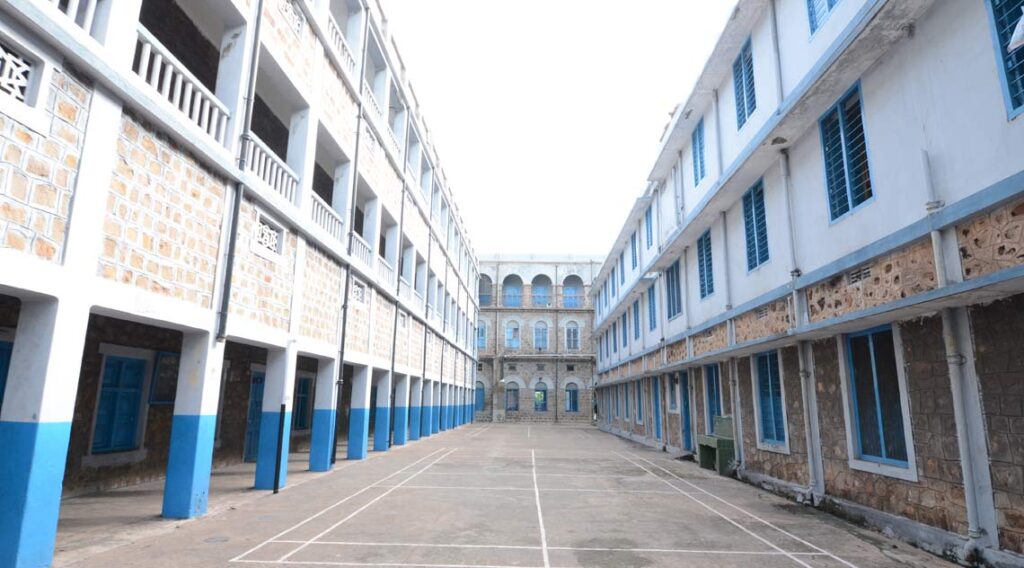
After 1873, new additions were made. To the South of the school (the present workshop) were fishermen’s huts which were purchased one after another to extend the school building. The area in between the eastern block and the southern block (the present quadrangle and boarding department) was a public pathway which for many years separated one part of the school from the other. With the permission of the municipality, this area was closed and therefore became part of the school premises. In the school itself, additional facilities were carried out till the beginning of the century.
According to the School Repot of 1875, there were 140 pupils of whom 83 were boarders – 63 of that boarders being orphans!
More additions were made by buying three more big buildings on the western side extending the school compound east-west, from the beach road to the next street separating it from the present day convent. In 1901, under Fr. J.L.Contat the principal, a two storeyed building was acquired and was used as the Bishop’s House till 1934 when it was demolished during the tenure of Fr. Baud to build the Chapel on the first floor under directions from Bishop Rossillon.
This Chapel was dedicated to St. Francis De Sales as the first chapel/institution in the Diocese of Visakhapatnam dedicated to the patron of the Congregation.
In 1906, the Government launched the scheme of ‘European Schools’ designed to improve the English Schools in the country to bring them up to the standard of similar schools in England. This meant new regulations, a new curriculum and a new building for the ‘St.Aloysius’ European School’. The Principal Fr. Contat, sometimes referred to as the builder of the school was busily engaged in construction and renovation of the existing buildings. In April 1908, the ground floor and the first floor of the main building facing the gate was completed comprising class rooms, a large dining hall and other rooms at a cost of Rs. 48,000/-. In 1914, the second floor of the wing facing the sea was constructed at a cost of Rs. 10,000/- and was used as a dormitory for the boarders of the school.
In 1926-27 the northern wing facing the road (present lab) was rebuilt transforming the first floor into classrooms and the second floor into a dormitory for the small students. The second floor of the main building was constructed in 1929-30 during the time of Fr. John Cowman who took over from Fr. Contat. Changes began to take place in India politically and economically. The system of education became part of it too. All these had an impact on St.Aloysius’ School also. The ‘European School’ became an ‘Anglo-Indian’ school. Till 1940, the pupils were chiefly Anglo-Indians. Special permission was required from the Inspectress of Schools to admit Indians. Gradually, the government allowed 33 percent seats-later increased to 50 percent for Non-Anglo-Indians.
After Independence, St.Aloysius’ School became a totally independent institution catering to the educational needs of all communities irrespective of caste or creed. Until 1947, the catering for the Priests and the boarders were entrusted to the Sisters of St. Joseph. When they late withdrew, they were replaced by the Sisters of St.Anne of Luzern, who stayed in the premises and took charge of the infirmary and the small boys gradually. Nursery classes were introduced under the care of the sisters. They withdrew from the school in 1980.
In keeping with the demand for school education, extensions were made to the existing buildings. Thus a new wing of the school, with three storeys was constructed in the early sixties by Bro. Jacob Vattachira, on the western side along the lane behind the main building. Parallel to it was the old kitchen and store rooms which were demolished by Fr. Alexander Kottam in 1985 and constructed a three storeyed building which now has the kitchen, store rooms and dining hall on the ground floor, the study halls and clothes room for the boarders on the first floor and the dormitory for them on the second floor.
In 1987, the old building purchased in 1922 and used as an infirmary was demolished, to build the present modern building which currently the primary classes. Sports and Games were always an integral part of the Aloysian curriculum and the sports field was the vacant land outside the building and across the road, directly facing the chapel. A boundary wall was immediately constructed around it and for the first time, the school officially had its very own playground!
To commemorate the ‘SESQUI CENTENARY’ (150 years) of the school’s existence, a STAGE was constructed in 1997 in the western part. Residential quarters for the support staff were also constructed in the lane outside the school during the same period.
It was also during that time the negotiations with the authorities of the PORT TRUST with regarding the shifting of the School due to the unavoidable fall of the dust in the premises and also due the ill health of the students and also for the modernization of the port and the increasing of the name and fame of the port in India. The Authorities of the port have been making negotiations with the management for the betterment of their business and for the welfare of the students’ health.
Lately this academic year the port authorities are still making an appeal to the management to shift the school and they promised to give the place. Now finally it is in the hands of the ALMIGHTY GOD who began the mission of education through the M.S.F.S. in the STEEL CITY can only do something for the betterment of the humanity. We hope and pray that the Almighty God will do what pleases Him in the coming days.
More Than a School: A Century-Spanning Commitment to
All-Round Development
|
Guided by Our Mission, Inspired by Our Vision
With a history spanning over 175 years, our school combines a rich tradition of Anglo-Indian culture with a commitment to modern, holistic education under the affiliation of the ICSE curriculum. Our magnificent building, featuring Gothic architecture, is a landmark by the seaside of Visakhapatnam.